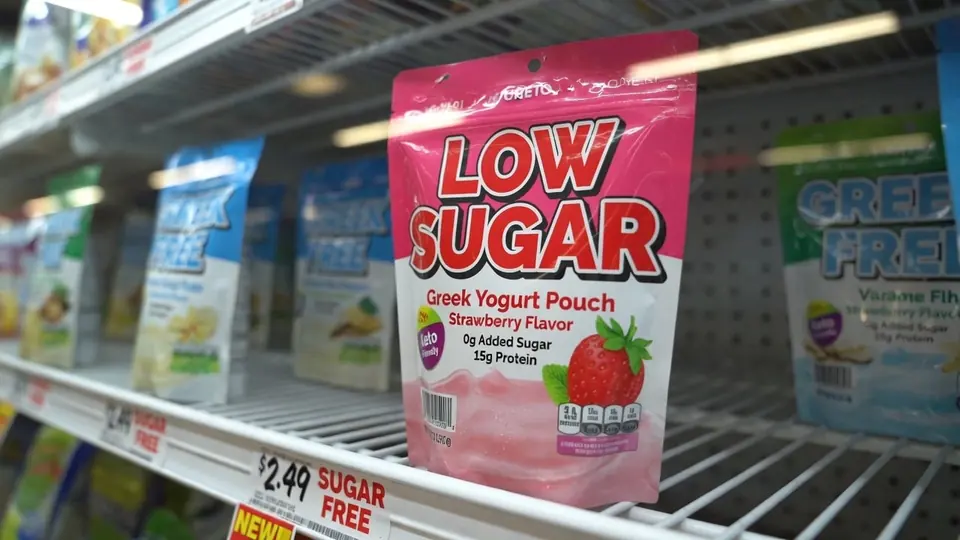
I was staring at a high-resolution render of a beverage pouch sent over by our visual team last week. The mockups looked clean under studio lighting, but the flavor callout across the front label still read BERRY in heavy curved display lettering. The vector design workspace was archived on a contractor drive across three time zones, while the retail buyer needed a proof showing MANGO before lunch.
When letters are already rendered directly into pixels, traditional graphic design workflows suddenly hit a wall. You either reconstruct the entire background art from scratch or search for a utility capable of modifying established raster graphics. Finding the right software for this exact scenario comes down to understanding what happens to letters once a graphic is flattened.
The first rule of editing packaging graphics is knowing when not to touch the pixels at all. If your original design file is still accessible in Illustrator or Canva, you should always return to that project and adjust the live text frames directly. Specialized pixel editing becomes necessary only when you are handed a flattened image where the vector paths no longer exist.
Many people assume that editing packaging online means visiting an automated mockup generator or browsing a catalog of canned design templates. Those platforms simply place preset digital stickers over generic three-dimensional containers and require you to adapt your product to their rigid presets. A genuine packaging text tool works from the opposite direction by accepting your existing finished artwork and letting you supply custom replacement letters.
Packaging surfaces are far more complex than ordinary flat graphics because they exist in dimensional space. Letters wrap across curved containers, fold over carton edges, and bend along flexible pouch gussets under simulated studio illumination. Any software attempting to swap words on these surfaces must understand perspective distortion, surface texture, and ambient highlights simultaneously.
When I needed to swap BERRY for MANGO on that beverage pouch render, standard retouching filters immediately smeared the metallic sheen across the pouch front. Purpose-built tools like Edit Text on Packaging approach the challenge by isolating the character boundaries while analyzing the substrate underneath. That separation allows the engine to paint over original letterforms and synthesize fresh characters that respect the existing angle and shine.
Reconstructing a complex package from scratch often requires re-licensing commercial typefaces, tracking down lost texture maps, and recalibrating intricate color gradients. A dedicated raster utility eliminates that overhead by evaluating the visual characteristics of surrounding words to inform the newly inserted phrase. With a tool designed to Edit Text in Image, you provide the replacement wording while the software manages the visual integration.
Selecting the right utility requires understanding the exact scope of your packaging challenge. You do not need a massive enterprise creative suite just to verify how an updated title looks on an existing box mockup. Instead, you need an engine that accurately detects text coordinates across complex surfaces and allows you to rewrite specific lines on demand.
A reliable solution should give you direct control over individual text strings rather than treating the entire label as an indivisible picture. Using a dedicated Packaging Text Editor gives you an interactive list of detected words so you can choose which phrases to modify and which to leave alone. Leaving a detected text line completely empty simply removes those characters from the finished picture.
One indispensable capability in any packaging utility is the ability to lock specific detected lines against accidental alteration. Every consumer package contains legally mandated disclosures that must remain completely untouched during visual revisions. Locking these lines guarantees that the software only modifies the specific marketing callout you intend to revise.
Packaging design carries strict legal obligations that visual teams must never overlook. You must lock declared fill quantities, production batch codes, and shelf-life timestamps so they are never altered during quick mockup revisions. Assertions regarding sweetener levels or low-calorie formulation, detailed ingredient panels, and climate or handling instructions must also stay locked down. These critical compliance elements belong strictly under the jurisdiction of approved regulatory documentation.
Modifying visual assets also demands strict operational discipline regarding intellectual property. You should only edit mockup renders, production proofs, or actual photos that you created or have explicit authorization to adjust. Furthermore, any altered image must strictly correspond to the physical packaging your company actually manufactures and ships to consumers.
It is vital to understand the technical boundary of what modern pixel editing tools provide. The software performs best-effort visual matching by examining the weight, slant, and highlights of surrounding characters rather than extracting a true vector font file. Because the final result is a raster synthesis rather than a lossless vector asset, you should treat it as an agile visual solution for proofs and previews.
When preparing files for text editing, you should work strictly with static raster formats including PNG, JPG, and WebP files. The system is engineered for deliberate single-image proofing rather than automated batch pipeline processing through an external API. Furthermore, because running high-precision synthesis models requires substantial compute infrastructure, the service does not offer an unlimited free tier.
Understanding the credit structure helps you plan your design revisions efficiently. Text detection runs completely free of charge, allowing you to examine detected strings and configure your edits before spending any balance. When you create an account, you receive trial credits upon signing in to evaluate the workflow on your own files. Once you trigger a generation, the cost scales with image dimensions, consuming 10 credits for 1K rendering, 20 credits for 2K rendering, and 30 credits for 4K rendering.
Different packaging constructions introduce distinct structural details that any editing tool must respect. A folding carton features crisp score lines, printed flaps, and subtle paperboard grain that must remain intact when you adjust front panel headers. Flexible retort pouches display continuous curvature and reflective film highlights, while transparent blister packaging layers plastic bubbles over printed backing cards.
When you change a word like BERRY to MANGO, the letter count and character shapes occupy different areas of the package face. The tool must cleanly erase the old letters while simultaneously reconstructing the underlying substrate texture, whether that is brushed cardboard or glossy foil. If an editing utility fails to rebuild that background smoothly, the replacement text looks detached from the physical structure.
Display typography on consumer goods rarely sits on a flat horizontal baseline. Designers frequently warp words along gentle arcs, slant script lettering for energy, or apply dimensional drop shadows to make titles pop on retail shelves. An effective tool evaluates these geometric distortions and applies equivalent transformations to your new replacement letters automatically.
Attempting to clean out baked text using generic clone stamps or spot healing brushes usually produces muddy, irregular smears. Those manual patches destroy the delicate halftone patterns and gradient shading that give package mockups their realism. When replacement characters are subsequently stamped over those damaged patches, the entire visual illusion falls apart under client review.
When deciding which tool to adopt for packaging updates, you should focus on workflow clarity and visual fidelity. Look for software that presents the detected text clearly, allows you to type exact replacements, and lets you isolate regions with precision locks. Avoiding bloated software suites enables your team to produce polished client proofs without friction.
In modern digital commerce and retail pitch meetings, speed of communication often determines whether an idea moves forward. Being able to present a clean visual proof with updated flavor names or regional branding helps stakeholders make decisions without delay. As long as your source images remain grounded in your genuine production standards, these focused edits streamline internal approvals significantly.
The dilemma of baked letters on finished mockups no longer requires throwing away hours of earlier design effort. Knowing whether your task calls for vector layout adjustments or pixel-level text replacement ensures you always choose the most efficient path. When flattened raster images are your only available starting point, a purpose-built text editor bridges the gap smoothly.
Edit Text on Packaging
Update net weight, ingredients, or product claims on finished packaging photos.
The Bottom Line
If you still hold the original vector workspace in Illustrator or Canva, always reopen that file and modify the live text frames directly. When you are left with a flattened PNG, JPG, or WebP render, use a specialized tool that synthesizes replacement letters directly into the lighting, curves, and textures of the physical package. Always lock your mandatory regulatory text, ensure the revised mockup matches what you actually produce, and rely on visual matching to generate quick, convincing proofs.
Sources
- https://en.wikipedia.org/wiki/Folding_carton
- https://en.wikipedia.org/wiki/Blister_pack
- https://en.wikipedia.org/wiki/Retort_pouch