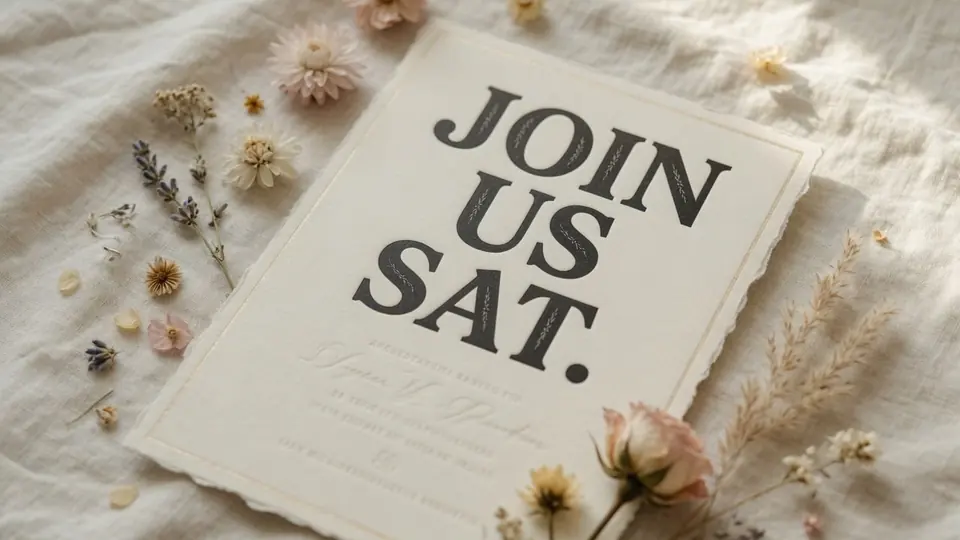
I was staring at the exported digital proof of a rehearsal dinner card that had just landed in my downloads folder. At the bottom right corner, sitting directly over an olive-branch watercolor wash, the response deadline read "RSVP FRI" instead of the required "RSVP SUN". The kitchen manager had pushed the headcount deadline forward by forty-eight hours, but the freelance designer who built the layout was already traveling without access to their workstation.
All I possessed was a single, high-resolution exported graphic file without any editable typographic layers. In that moment, opening a blank document to recreate the entire layout from scratch felt like an absurd waste of energy. You know the exact frustration of having an otherwise flawless piece of stationery ruined by three incorrect capital letters.
Before you attempt any modification on the raw pixels of an image, you must verify where the design originated. If your invitation is still saved inside Canva, Figma, Illustrator, or an editable desktop publishing document, you should close your graphics converter and return directly to that source application. Modifying the original text box preserves font kerning, vector geometry, and pure background clarity without introducing compression artifacts. You should only turn to pixel-level text replacement when you are handed a flattened bitmap and have no access to the underlying template.
A flattened graphic file treats letters as collections of colored pixels rather than distinct typographic characters. When you attempt to wipe out letters with a standard clone stamp or airbrush, you inevitably smudge the background paper texture or destroy delicate floral elements. That is why people wonder what software can selectively read and swap typographic details on static files. This need is precisely where an image-focused utility like Edit Text on Invitation enters your workflow.
ReWords AI is built specifically for existing images rather than serving as an invitation marketplace. You will not find downloadable wedding templates, birthday card packs, or party theme catalogs on the platform. You provide your own pre-existing graphic, review the detected letterforms, and type the exact replacement characters you want to appear. The engine focuses entirely on modifying what is already visible rather than selling you a pre-packaged layout.
When you upload a flattened invitation, the system performs an initial scan to identify every line of visible text across the card. This initial detection phase consumes zero credits, allowing you to confirm that the engine recognizes your specific wording before you commit any resources. You can see how the boundary boxes map against your script lines, date blocks, and host names. Once the boxes appear, you take direct control over which lines stay untouched and which lines receive new words.
The visual core of the process relies on sophisticated pixel synthesis rather than conventional system fonts. Using Edit Text in Image allows you to update phrases directly inside the raster data of your file. The platform analyzes the surrounding color distribution, optical weight, baseline angle, and ambient grain to render replacement letters that blend with the card. It does not extract or install an actual OTF or TTF font file on your computer, nor does it perform lossless vector rasterization.
Because stationery often features bespoke calligraphy and textured cardstock, visual synthesis must operate on a best-effort basis. If your card uses heavy gold foil embossing, metallic leafing, or intricate flourish swashes, the engine attempts to replicate that surface style based purely on adjacent pixel clues. You should evaluate the generated result critically to ensure the simulated strokes match your expectations. For standard sans-serif details like "RSVP SUN", the system matches the geometric proportions and tone of the original lettering.
Selective preservation is critical when handling formal stationery where only a single phrase requires revision. The interface includes a Lock feature that allows you to freeze any recognized line so that its pixels remain completely unaltered. On my rehearsal dinner proof, I locked the couple's names, the venue address, and the registry note, leaving only the response date line unlocked. If you encounter an unwanted line of text that you simply want to erase, leaving that line's replacement input completely blank instructs the system to patch the background over the letters.
Managing generation costs requires an understanding of how credits function on the platform. Every new account receives trial credits upon signing in, which gives you the freedom to test the output quality on your own files. When you are satisfied with your text inputs and click the Generate button, your balance is deducted based strictly on the output resolution you select. Generating a 1K resolution image consumes 10 credits, a 2K resolution image consumes 20 credits, and a full 4K resolution image consumes 30 credits.
Choosing the right resolution tier depends on how you plan to distribute the revised invitation. If you are sending the card through email, group chat channels, or wedding websites, a 1K or 2K output provides ample clarity for mobile screens. If you intend to take the digital file to a commercial print shop for physical card production, opting for 4K preserves the sharpness needed for fine paper printing. Selecting your target resolution beforehand ensures you spend your credits efficiently without unnecessary re-runs.
The platform is intentionally designed for straightforward personal and project-based edits rather than mass automation. There is no unlimited free subscription tier, and the platform does not offer a bulk processing API for programmatic editing. You interact with each card individually through the web interface, making deliberate choices about each line of typography. This single-file workflow prevents unintended batch errors and guarantees that you inspect every visual boundary before finalizing your project.
File compatibility is another practical consideration you should verify before starting your project. The tool accepts static raster images in PNG, JPG, and WebP formats, which cover virtually every standard export from photo editors and camera rolls. Animated files, multi-page PDFs, and layered vector formats cannot be loaded into the workspace directly. If you have a PDF proof from a print shop, you must first export that single page as a flat PNG or high-quality JPG before uploading it.
Navigating wedding and event stationery deadlines often involves sudden changes that test social etiquette. Response dates dictate catering prep, seating charts, and place card assignments for hosts who need firm numbers. Using an Invitation Text Editor gives you the agility to handle last-minute adjustments without delaying your entire mailing schedule. When your host committee alters a deadline from Friday to Sunday, having a practical way to update the graphic prevents costly re-design fees.
Once the engine completes your requested generation, you should inspect the modified area under close magnification. Check that the baseline of your new text aligns naturally with adjacent design elements and decorative margins. Verify that the contrast between your letters and the background texture remains comfortable to read for elderly guests and vendors alike. If your invitation features a delicate watercolor pattern, confirm that the reconstructed paper grain appears consistent across the patched area.
It is equally important to review the overall balance of the card to ensure that changing word length does not disrupt visual harmony. Swapping "RSVP FRI" for "RSVP SUN" preserves the exact character count, making the visual replacement seamless within the layout. If you replace a short phrase with a significantly longer sentence, the synthesized letters will adjust their kerning to fit the designated line bounds. Keeping your replacement wording concise helps maintain the original aesthetic balance envisioned by the designer.
Correcting flattened graphics will never completely replace the utility of an original vector source file. When you have the native workspace open, editing live text boxes will always remain the gold standard of digital publishing. But when deadlines press, designers are unreachable, and only a flattened proof remains on your desk, pixel-level text synthesis provides a viable path forward. It bridges the difficult gap between an uneditable image and a completed event preparation.
Taking the time to proofread the entire card after modifying a single line is a vital final habit. Look beyond the altered date to ensure that phone numbers, venue addresses, and dress codes remain clear and legible. A polished invitation reassures your attendees and sets a gracious, organized tone for the celebration ahead. With the correct wording locked in place and your graphic cleanly updated, you can deliver your invitations with complete confidence.
Edit Text on Invitation
Update RSVP deadlines, event times, or venues on your finished invitation.
The Bottom Line
Modifying text on a flattened invitation image is a pragmatic solution when you cannot access original design files. ReWords AI gives you a direct way to alter fixed letters on static PNG, JPG, or WebP files by synthesizing replacement pixels to match existing typographic styles. Remember to lock unchanged lines, leave unwanted fields blank, and pick the 1K, 2K, or 4K resolution tier that fits your display or printing requirements. Always rely on editable source files when available, but use pixel-level editing to solve urgent stationery revisions with minimal friction.
Sources
- https://en.wikipedia.org/wiki/RSVP
- https://en.wikipedia.org/wiki/Place_card
- https://en.wikipedia.org/wiki/Courtesy