The top AI image text editors in 2026, tested on real editing tasks. Find the right tool for font matching, background reconstruction, typo fixes, and seamless text replacement.
July 2026 · 12 min read
On this page:
- What Is an AI Image Text Editor?
- What to Look for Before You Choose
- The Top AI Image Text Editors in 2026
- Where These Tools Commonly Fall Short
- Mistakes to Avoid When Using AI Text Editors
- Which Tool Fits Your Use Case?
- FAQ
Picking an AI image text editor in 2026 is harder than it needs to be. Most tools market text editing as a feature checkbox rather than something they've actually engineered well. I've tested the leading options on real-world tasks: correcting typos on photographic backgrounds, swapping copy in multi-element marketing layouts, removing baked-in watermarks, and running localization passes across language variants of the same asset. The quality gap between tools is significant enough to affect both your output and your sanity. Here's my honest breakdown of what's worth using, what each tool does well, and where each one lets you down.
AI Image Text Editor
Replace, fix, or remove words with our free online AI image text editor and style matching.
What Is an AI Image Text Editor?
An AI image text editor uses artificial intelligence to detect, extract, and modify text embedded in a flattened image file — without requiring the original editable design layers. When a file is exported to JPEG or PNG, the text fuses into the pixel grid and stops being editable content. Traditional editing software treats those pixels the same as any other part of the image. An AI text editor takes a different approach: it uses optical character recognition to identify which pixels constitute text, isolates them as editable regions, applies font matching to any replacement content, and uses generative inpainting to rebuild the background after edits are applied.
The practical scenario is simple: you have a finished image with text in it, the original design file is gone or impractical to retrieve, and you need to change, correct, or remove some of that text. AI tools make this possible in minutes — no Photoshop, no design experience, no hunting for source files.
What to Look for Before You Choose
Before comparing specific tools, the criteria that actually determine output quality are worth naming clearly — because most comparison articles replace them with feature counts.
- Text detection accuracy — Does the tool reliably find all text in the image? Including text with drop shadows, outlines, text on busy photographic backgrounds, and stylized headlines with unusual letterforms. Tools that miss text force you into manual workarounds that erase the efficiency benefit.
- Background reconstruction quality — How does the image look after text is removed or replaced? This is where the most visible quality gap between tools appears. The background left behind should look as if text was never there. The best tools achieve this on most backgrounds. The worst leave obvious artifacts.
- Font matching accuracy — Does the replacement text look like it belongs in the original image? The tool needs to identify font family, weight, size, color, letter spacing, and effects like shadows or outlines, then apply all of them consistently to the new content.
- Multi-element layout handling — Does the tool understand a full image composition rather than treating each text block in isolation? This matters for marketing assets where a headline, subhead, body copy, and CTA all need to maintain visual hierarchy after separate edits.
- Workflow speed — How many steps from upload to finished download? Does the interface add friction or remove it? Friction compounds fast when you're editing a batch of assets, not just one image.
The Top AI Image Text Editors in 2026
1. ReWords AI — Best Overall for Seamless Text Replacement
ReWords AI is purpose-built for one task: replacing existing text in finished images while preserving the original look. It's not a general-purpose image editor with text editing bolted on — the entire product is engineered around text detection, background reconstruction, font analysis, and text rendering.
What sets ReWords AI apart is how it handles the complete pipeline. Upload an image, and it automatically detects all text regions. Click on any detected text (or draw a box around anything it missed), type your replacement, and generate. The tool erases the original text, reconstructs the background, analyzes the font style, and renders new text that matches the original as closely as the image allows.
Best for: Anyone who needs to replace text in images quickly and cleanly — marketers, e-commerce sellers, content creators, developers, localization teams.
Key features:
- Automatic text detection with manual selection fallback
- AI-powered background reconstruction via inpainting
- Font style matching (family, weight, size, color, spacing)
- Works on desktop and mobile browsers, no installation
- Supports PNG, JPG, WebP
- One credit per image, unlimited text regions per edit
Strengths:
- Handles the full workflow from detection to download in under a minute
- Background reconstruction quality is consistently strong on photographic, gradient, and textured backgrounds
- Free trial edit for new users, no credit card required
- 2K and 4K resolution exports on subscription plans
- API available (beta) for developers
Limitations:
- Font matching on highly custom or hand-lettered typefaces requires review before publishing
- Very heavily compressed JPEG source files may produce artifacts at edit points
- Not a full image editor — focused exclusively on text replacement and removal
Pricing: Free trial edit / credit-based plans / subscription for high-volume use
2. Fotor — Best Free Option for Font Matching
Fotor's Auto Text Grab scans an image and makes all text areas editable in a single step. Its font detection identifies not just the typeface family but also weight, color, shadow effects, and letter spacing. A prompt-based editing mode lets you type natural language instructions like "change the date to June 20," and the AI interprets and applies the change without manual selection. Fotor also includes a built-in translation feature for localization workflows.
Best for: Quick typo fixes, marketing updates, teams that need strong font matching on a budget.
Strengths:
- Best-in-class font matching among free-tier tools
- Prompt-based editing reduces steps for common updates
- Translation feature adds value for multi-market teams
Limitations:
- Background reconstruction on complex photographic backgrounds can be uneven at the free tier
- Daily usage limits on the free plan
Pricing: Free plan with daily limits / $8.99/month Fotor Pro
3. Canva — Best for Teams Already in the Canva Ecosystem
Canva's Grab Text feature lets you click on any text in an uploaded image and edit it in place. Performance is strongest on template-style images and social graphics where backgrounds are relatively simple and fonts are standard. Canva's genuine advantage is workflow integration: teams already using Canva for content creation can add text corrections without switching platforms. The technical ceiling is lower on complex images, but for social content and template work, the friction savings are real.
Best for: Social media content teams, template customization, teams whose workflow already lives in Canva.
Strengths:
- Seamless integration with Canva's broader design environment
- Lowest learning curve of any tool on this list
- Solid performance on designed graphics and standard social templates
Limitations:
- Unreliable on photographic backgrounds and complex print materials
- Inconsistent on stylized or non-standard fonts
- Requires working inside Canva's full interface — not a standalone quick-fix tool
Pricing: Free / $15/month Canva Pro
4. Adobe Firefly via Photoshop — Best for Professional Print Output
For professional output at full print resolution, Adobe Firefly's generative AI inside Photoshop is the most technically capable option. Generative Fill produces the cleanest background reconstruction available, including on complex photographic and textured backgrounds. Font matching through Adobe Fonts is deep and precise. The trade-off is a professional price tag and a steep learning curve. This isn't a browser-based quick-fix tool — it's the right answer when you already work in Photoshop and need AI text editing to meet professional output standards.
Best for: Professional designers, agencies, high-resolution print output, anyone in the Adobe ecosystem.
Strengths:
- Best background reconstruction quality at any resolution
- Handles full print-resolution files without compression
- Full creative control alongside AI assistance
Limitations:
- $20.99/month minimum (Creative Cloud Photography Plan)
- Steep learning curve compared to every other tool on this list
- Overkill for simple text corrections
Pricing: $20.99/month Creative Cloud Photography Plan
5. Refont AI — Best for High-Volume Localization
Refont AI is built around one thing: replacing text in images while preserving original formatting. The interface is stripped to exactly what the task requires. Detection is reliable, font matching is strong on standard typefaces, and the upload-to-download cycle is fast. For teams running high-volume repetitive text replacement — for example, localization teams updating the same asset across 10 language versions — the minimal interface removes overhead that compounds across large batches.
Best for: High-volume text replacement, localization teams, repetitive asset updates.
Strengths:
- Fastest workflow for single-text-block replacements at volume
- Clean, minimal interface with no feature overhead
- Good font matching on standard fonts
Limitations:
- Less sophisticated background reconstruction on complex images
- Limited to text replacement and removal — not a broader image editor
- Less capable with multi-element layouts
Pricing: Free tier / paid plans for volume
6. Musely — Best for Simple, One-Off Corrections
Musely is a quick-access browser tool positioned around speed. On clean, high-contrast text against a simple or solid background, it performs well: detection is fast and font matching is accurate. On complex photographic backgrounds or stylized text, the background fill can leave visible artifacts. It's a solid free option for fast single corrections where the source image is straightforward.
Best for: Non-designers who need a fast, simple interface for basic text corrections.
Strengths:
- Fast and accessible for simple corrections
- Interface suitable for non-technical users
Limitations:
- Background reconstruction shows artifacts on complex images
- Not suited to multi-element layouts or professional output
Pricing: Free tier available
Where These Tools Commonly Fall Short
Understanding where AI text editing tends to break down before you commit saves significant time. These are the most consistent failure points across all tools.
Custom and Stylized Fonts
Font matching works reliably on standard typefaces. On custom brand fonts, heavily stylized display typefaces, hand-lettered text, and script fonts, every AI tool produces an approximate match that may need manual adjustment to weight, spacing, or color. This is a constraint of current font-matching technology, not a flaw in any specific tool.
Non-Latin Scripts and Right-to-Left Languages
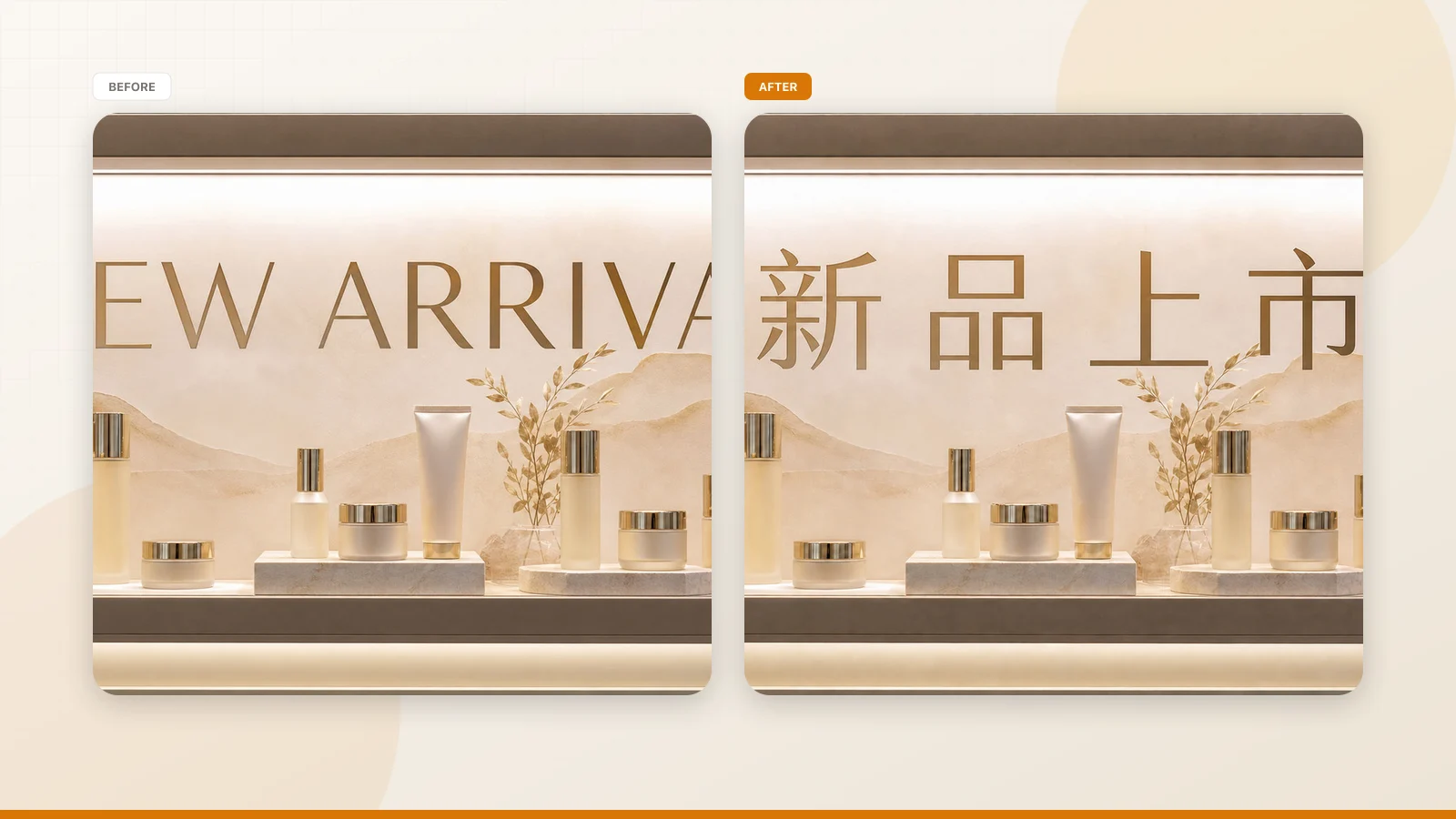
Most tools handle Latin-based text well. Support for Arabic, Hebrew, CJK characters, and right-to-left text direction is inconsistent. Some tools detect the text correctly but fail on character rendering. Others break line direction in the replacement. Always test with your specific language before committing to a tool.
File Size Limits
Most browser-based AI text editors cap uploads at 20–25 MB. High-resolution print files regularly exceed this. Downsizing before uploading is the workaround, but it reduces source quality and therefore reconstruction quality.
Heavily Compressed Source Images
JPEG compression artifacts make both text detection and background inpainting harder. The more compressed the source file, the more likely the output will show artifacts at edit points. Higher-quality source files produce noticeably cleaner results across every tool.
Mistakes to Avoid When Using AI Text Editors
- Expecting pixel-perfect results on every image. AI text editing is impressive, but it's not magic. Complex backgrounds, unusual fonts, and low-quality sources will challenge any tool. Set expectations accordingly and review output before publishing.
- Using low-resolution source files. Garbage in, garbage out. A 500px-wide JPEG will never produce the same quality as a 3000px PNG. Start with the highest quality source available.
- Ignoring the review step. Even the best tools occasionally produce subtle artifacts — a slightly off-color patch, a faint outline where text was removed, a minor font weight mismatch. A 10-second review before downloading catches most issues.
- Choosing a general-purpose editor for a text-specific task. If your primary need is replacing text in finished images, a purpose-built tool like ReWords AI will outperform a general image editor that happens to include text editing. Specialization matters.
Which Tool Fits Your Use Case?
| Use Case | Recommended Tool |
|---|---|
| Quick text replacement in any image | ReWords AI |
| Free tool with strong font matching | Fotor |
| Teams already using Canva | Canva |
| Professional print-resolution output | Adobe Firefly via Photoshop |
| High-volume localization batches | Refont AI |
| Simple one-off corrections on clean images | Musely |
FAQ
Can AI really match the exact font in my image?
AI tools analyze glyph shapes, weight, size, color, and spacing to produce a close match. On standard fonts, the result is usually very good. On custom or highly stylized fonts, expect an approximation that may need minor review.
Is there a completely free tool that does this well?
Several tools offer free tiers — Fotor, Canva, Musely, and Refont AI all have free options with varying limitations. ReWords AI offers a free trial edit for new users. For ongoing professional use, paid plans typically unlock higher resolution, batch processing, and daily usage limits.
Will this work on handwritten text?
Results vary. Clean, high-contrast handwriting on simple backgrounds works better than cursive or overlapping script on textured surfaces. Test with your specific image before relying on the output.
Can I use these tools for commercial purposes?
Check each tool's terms of service. Most allow commercial use of edited images, but policies vary on AI-generated content rights and attribution requirements.